

by Kati LeBreton
September 29, 2025
One of my comfort movies is Beauty Shop, starring Queen Latifah. It’s a comedy about a single mom and hairstylist named Gina. After a disagreement with her awful boss (hysterically played by the one-and-only Kevin Bacon), Gina decides to open her own salon — and hilarity ensues. My family owned this movie on DVD, and I’m pretty sure my brother and I can still recite most of the lines.
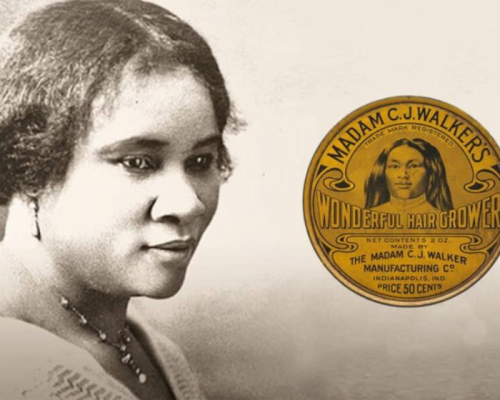
There’s a moment in the movie that has stuck with me since I first watched it in 2005. After receiving the keys to her new shop, Gina is busy cleaning and decorating the space. She lovingly hangs a black-and-white portrait of a gorgeous woman on the wall of the shop, whispering, “There you go, Madam C.J.”
From that moment on, I was intrigued. Who was this “Madam C.J.”? Was she a real person? Why did Gina hang a portrait of her on the salon wall? It only took a quick Google search on my family’s humongous desktop computer (remember, this was 2005) to send me down a rabbit hole. Not only was this a real person — she was the first self-made female millionaire in the United States. The story of Madam C.J. Walker is one that every female entrepreneur and woman business owner should know and be inspired by.
The Early Life of Madam C.J. Walker
Madam C.J. Walker was born Sarah Breedlove on December 23, 1867, in Delta, Louisiana — right here in our state. Her parents, Owen and Minerva Breedlove, had five other children, and life wasn’t easy. Her parents and siblings had been enslaved on a plantation in Madison Parish, but Sarah was the first in her family to be born free after the Emancipation Proclamation.
Tragedy struck early. Her mother died in 1872, likely from cholera, which had been spreading along the Mississippi River. Her father remarried but passed away just a year later. At ten, she moved to Vicksburg, Mississippi, to live with her sister Louvenia and brother-in-law Jesse Powell, where she started working as a domestic servant.
In 1888 at the age of twenty-one, Sarah moved to St. Louis with her daughter, Lelia, where three of her brothers were already living. She found work as a laundress, earning barely over a dollar a day — but she was determined to give Lelia a proper education.
Building a Business Empire
Sarah suffered from severe dandruff and scalp problems, including bald patches. Harsh cleaning products used for hair and laundry didn’t help, and other factors — poor diet, illnesses, and irregular bathing (common in an era without indoor plumbing, central heating, or electricity) — only made things worse. These challenges would later spark her groundbreaking work in hair care and entrepreneurship.
At first, Sarah picked up her hair-care know-how from her brothers, who worked as barbers in St. Louis. Around the time of the 1904 Louisiana Purchase Exposition (basically the World’s Fair in St. Louis), she began selling products for Annie Turnbo Malone — another African American hair-care entrepreneur who owned the Poro Company. Unfortunately, sales at the fair didn’t go well, since the African American community was mostly overlooked.
While working for Malone — who would later become a major competitor — Sarah started experimenting with her own ideas and developing her own product line. By July 1905, at age 37, she moved with her daughter Lelia to Denver, Colorado. There, she kept selling Malone’s products while building her own hair-care business.
In 1906, Sarah married Charles Walker and rebranded herself as “Madam C.J. Walker,” inspired by French beauty industry pioneers. Charles became not just her husband but her business partner, helping with advertising and promotions. She went door to door selling her products, teaching other Black women how to care for and style their hair.
By 1908, they moved to Pittsburgh, Pennsylvania, opened a beauty parlor, and established Lelia College to train “hair culturists.” As part of her mission to empower Black women economically, Walker created training programs in what she called the “Walker System” for her network of licensed sales agents, who earned generous commissions.
Empowering Women Entrepreneurs
In 1910, Madam Walker set up the headquarters for the Madam C.J. Walker Manufacturing Company in Indianapolis. She bought a house and factory at 640 North West Street, later expanding to include a larger factory, beauty salon, and training school for her agents. She even added a laboratory for product research. Many of her key staff members were women.
At the peak of her career (between 1911 and 1919), Walker and her company employed thousands of women as sales agents. By 1917, they had trained nearly 20,000 women. These women worked tirelessly — going door to door across the U.S. and even the Caribbean — demonstrating and selling Walker’s products, which came in tin containers featuring her image.
Walker knew how powerful advertising could be. She poured resources into ads — especially in African American newspapers and magazines — and traveled extensively to promote her brand. But her work went beyond just hair products. She taught Black women not only how to sell and style hair but also how to budget, run businesses, and become financially independent.
In 1917, Walker created the National Beauty Culturists and Benevolent Association of Madam C.J. Walker Agents, which later became the Madam C.J. Walker Beauty Culturists Union of America. Their first annual conference was held in Philadelphia in the summer of 1917, drawing 200 attendees. It was one of the first national gatherings of women entrepreneurs to talk about business. Walker made it special by awarding prizes to the women who sold the most products, recruited the most agents, or contributed most to their communities.
A Legacy Every Woman Business Owner Can Learn From
The story of Madam C.J. Walker is unlike any other. Despite major disadvantages and setbacks (like limited education, the era in which she was living, and her financial status), she was resilient. And she didn’t stop once she found her fortune — she poured back into the young women in her community, leading the next generation of female business owners and entrepreneurs.
She deserves a spot on everyone’s wall.